
Insight · Life · Notes to Self

Grief Doesn’t Leave. You Just Get Bigger Around It

People told me it gets easier with time. I believed them for a while. It seemed like the kind of thing that had to be true, the way a lot of comforting things seem like they have to be true.
But it doesn’t get easier. Not really. You just stop being surprised by it.

Grief, I’ve come to think, is not a phase. Its not a thing you move through and come out the other side, changed but free. Its more like it becomes part of the furniture. You stop bumping into it in the dark because you’ve memorized where it lives. But its always there, in the corner, quiet and patient.
For a long time I thought that meant I was doing something wrong. That I hadn’t healed properly, or hadn’t let go, or whatever the right words are that people use. There’s a whole vocabulary around grief that’s meant to be helpful and often just makes you feel like you’re grieving incorrectly.
You’re not supposed to still think about it. You’re supposed to have found meaning, found closure, found the lesson. As if loss is a classroom and you just need to pass the test.

I don’t think that’s how it works.
What I think happens, what happened to me at least, is that you grow around the grief. Your life expands slowly in other directions. New things come. New people, new moments, new versions of yourself. And the grief stays the same size but you get bigger. So it takes up less of you, percentage wise. Not because it shrinks, but because you grow.
Some days you forget it’s there entirely. You laugh at something stupid and for a second you’re just free. And then it comes back, sometimes gently, sometimes like a hand on the chest. And you realize you hadn’t forgotten, not really. You were just carrying it in a different pocket.

There’s a kind of intimacy to grief that I didn’t expect. It knows you very well. It knows exactly which memory to surface when you’re alone at 2am, exactly which song will undo you, exactly when your guard is down. In a strange way it keeps you connected to the thing you lost. To stay in grief is, in some sense, to stay close.
Maybe that’s why letting go feels like betrayal. Not because you’re weak, but because the grief itself is a form of love. The last form of love you have left to give.

I don’t know when I stopped waiting to be done with it. Somewhere along the way I must have quietly accepted that this is just part of me now. That I carry this person, this loss, this before-and-after, with me everywhere I go.
And oddly, that acceptance didn’t feel like defeat. It felt like something settling into place.
There’s a kind of peace on the other side of that, not the peace of forgetting, but the peace of knowing you can hold it. That you have held it. That you will keep holding it, and still be okay.
Still be here.

Time doesn’t heal grief. But it teaches you how to live alongside it. And sometimes, on the really good days, that’s enough.

Insight · Life · Notes to Self

When I lost my voice

It all started when I woke up one morning and noticed that my voice was hoarse and weak. I assumed it was just a cold or a minor sore throat, but as the day went on, my voice continued to deteriorate until I could barely speak above a whisper. I quickly realized that this was not just a minor inconvenience, it was a major problem.

I visited my doctor and found out that I had developed laryngitis, an inflammation of the larynx (voice box) that can cause loss of voice or hoarseness. My doctor advised me to rest my voice as much as possible and gave me some medication to help reduce the inflammation. For the next week, I was unable to speak and had to rely on text messaging, email, and other forms of written communication. I had to cancel several appointments and meetings because I couldn’t speak, and I felt like I was missing out on important conversations and opportunities.

But the most isolating part of this experience was the fact that it happened in a virtual world. We live in a time where most of our communication is done through phone calls, video conferences and virtual meetings. Not being able to speak in this environment made me feel like I was missing out on important conversations and opportunities. I felt like I was invisible, and it was a difficult feeling to shake.The frustration of not being able to speak was compounded by the fact that there was nothing I could do to fix it. I had to just wait for my voice to come back, and it felt like an eternity. But as the week went on, I started to see the silver lining. I learned to appreciate the power of written communication and the beauty of nonverbal cues. I also learned to be a better listener and to pay more attention to the people around me.

It was frustrating not being able to speak, but it also made me realize how much I rely on my voice and how important communication is in my daily life. It was a reminder that our voices are a gift and that we should cherish and protect them. The experience was a humbling one. I realized how much I took my voice for granted and how much it affected my daily life.

It made me appreciate the simple things, like being able to say “hello” or “thank you.”

In the end, my voice came back, but the experience taught me to take better care of my health. If you ever find yourself in a similar situation, remember that it’s important to seek medical attention and to be patient. And most importantly, appreciate the small things in life like your ability to speak and communicate.

Love · Notes to Self

Love myself – I do

“Love myself ……………I do.

Not everything, but I love the good as well as the bad.

I love my crazy lifestyle, and I love my hard discipline.

I love my freedom of speech and the way my eyes get dark when I’m tired.

I love that I have learned to trust people with my heart, even if it will get broken.

I am proud of everything that I am and will become.”


Johnny Weir
Coincidences · Notes to Self

Another book chooses me ………

The strange coincidence of books coming into my life at appropriate time continues…. there have been multiple instances of books “finding me” or “choosing me” at appropriate time (and especially during my travels to Europe.)

I have written about my previous experiences here and here.

This time its about “The Diary of a Young Girl” by Anne Frank.

The Diary of a Young GirlThe diary of Anne Frank was published in the Netherlands on 25 June 1947. Now this is where it becomes weird coincidence.

I pick up this book on 22nd March (but note, do not start reading it till 23rd June) and on 27th March we make plans for summer vacation in Europe. I have absolutely no clue that book is set in Amsterdam. On my flight to Amsterdam (on 23rd June), I start reading this book and was awed by the coincidence.  I am again in same city while reading the book where it was written (and had reference). I fly out of Amsterdam on 25th June (on the day book was published).

The house in which Anne Frank and her family hid from the Nazis from 1942 to 1944. (Photo by DESK/AFP/Getty Images)
The house in which Anne Frank and her family hid from the Nazis from 1942 to 1944 in Amsterdam. (Photo by DESK/AFP/Getty Images)

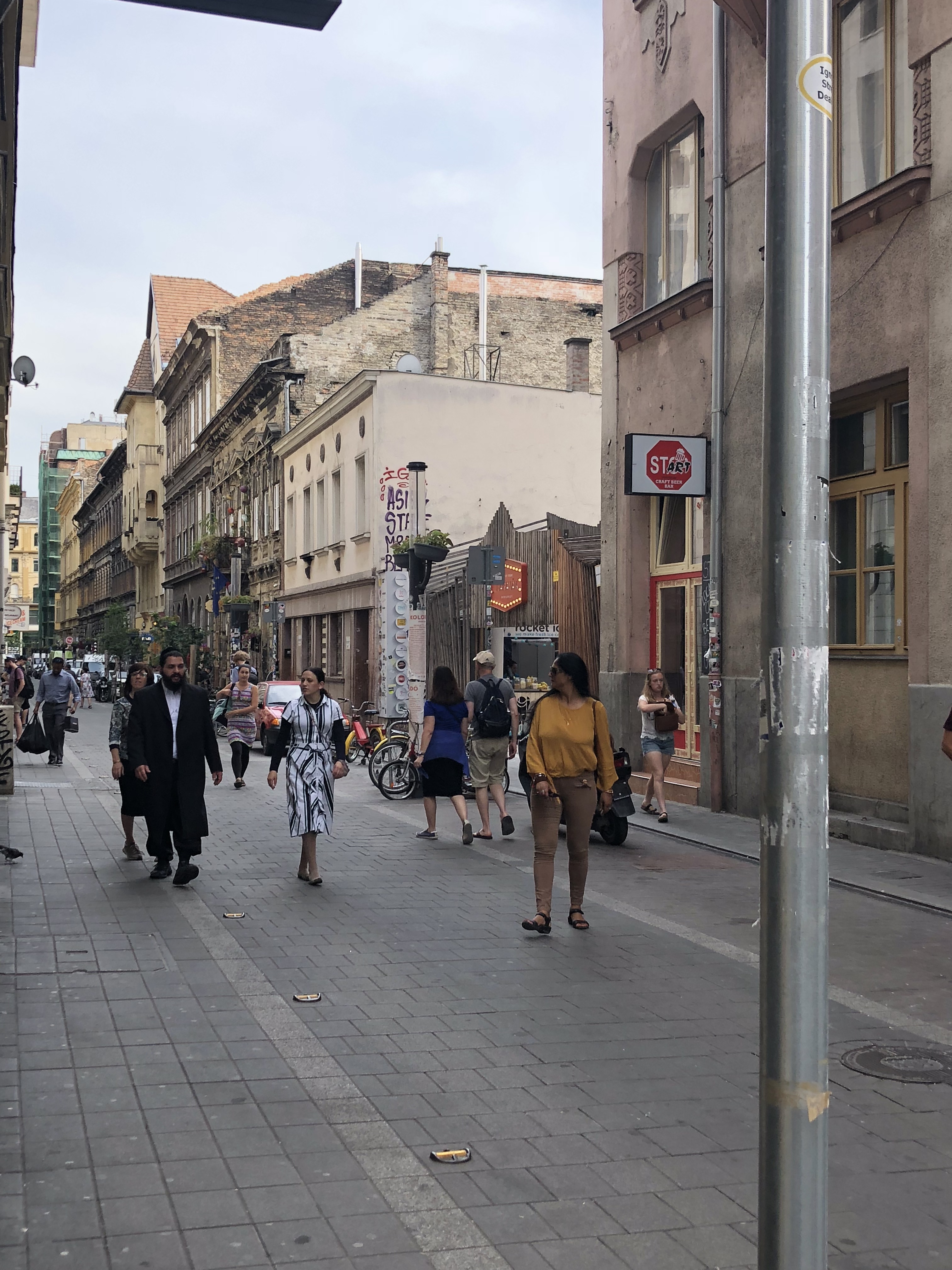
From Amsterdam we traveled to Prague, Vienna and reach Budapest AND all this while I  am reading this book (which has such a close association with holocaust). I had absolutely no idea about the holocaust impact in Budapest and how many Jews have died here.  On our fourth day at Budapest, we decide to visit Dohány Street Synagogue which was just couple of blocks away from where we were staying. The young guide in Synagogue passionately explained us the history of synagogue and the  fate of Jewish in Budapest.  It was surreal experience for me visiting the synagogue and adjacent Jewish Cemetery ( The presence of the latter is quite unusual, as Jewish religious rules forbid the burial of the dead near places of worship. Its existence is due to the tragic events of World War II: in the extremely brutal winter of 1944-45, tens of thousands of Jews died in the Jewish Ghetto of Budapest, and over 2,000 needed to be buried in the courtyard of the Synagogue), which I think will have need lot of nerve to jot down.

THE BUDAPEST GHETTO

In November 1944, the Arrow Cross ordered the remaining Jews in Budapest into a closed ghetto. Jews who did not have protective papers issued by a neutral power were to move to the ghetto by early December. Between December 1944 and the end of January 1945, the Arrow Cross took as many as 20,000 Jews from the ghetto, shot them along the banks of the Danube, and threw their bodies into the river.

Only after visiting this site, I came to know that the apartment we have been staying in was in historic Jewish quarters!!!!

And I finish last pages of this book while I am leaving Budapest !!!!!!

577

Note to Self – need retrospection on what this book was trying to teach me and what life lessons my soul is yearning for in this lifetime. Coincidences can’t be so consistent and I have to learn to interpret these signs.  I have to seek out my calling!!!